The Essential Role of Day Name Handwriting Practice in Early Literacy
The journey into literacy for young children is paved with fundamental steps, one of which is mastering the recognition and formation of common words. Among these foundational vocabulary items are the names of the days of the week. A dedicated tool for this learning phase is a Day Name Handwriting Worksheet. Such resources provide a structured, engaging, and effective method for children, particularly in preschool and kindergarten settings, to develop both their writing mechanics and their understanding of temporal concepts.
Understanding the Anatomy of a Days of the Week Worksheet
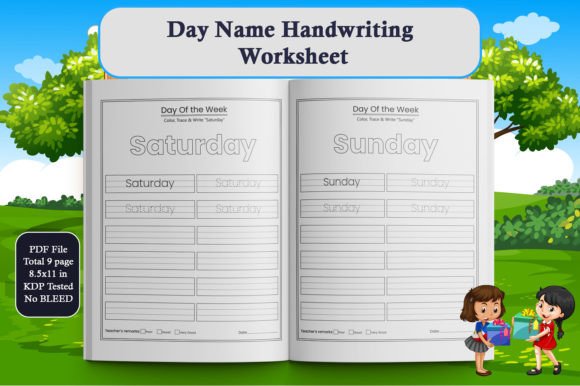
A typical Day Name Handwriting Worksheet is more than a simple page with words to copy. It is a carefully designed educational instrument. At its core, it focuses on the seven day names: Sunday, Monday, Tuesday, Wednesday, Thursday, Friday, and Saturday. These worksheets often begin with large, clear models of each word, showcasing proper letter formation and capitalization. The primary activity is tracing, where children follow dotted or faint outlines of the letters, which guides their hand movements and builds muscle memory for writing shapes. Following tracing exercises, there are usually spaces for independent practice, encouraging the child to write the day name on their own.
This progression from guided to independent writing is crucial for skill development. Furthermore, high-quality worksheets incorporate visual elements, perhaps associating each day with a simple icon or color, to aid in memorization and make the abstract concept of days more concrete. The physical specifications of such a worksheet book, like an 8.5 x 11 inch PDF format with a tested, bleed-free interior, ensure it is practical for both classroom printing and commercial publishing platforms like Amazon KDP.
The Multifaceted Benefits of Targeted Handwriting Practice
Introducing handwriting through familiar, high-frequency words like the day names offers a cluster of interconnected advantages. First, it directly enhances fine motor skills. The act of controlling a pencil to trace and write specific letters strengthens the small muscles in the hands and fingers, a prerequisite for all future writing tasks. Second, it builds letter recognition and phonemic awareness. Children see the letters repeatedly, hear the word as they write it, and begin to connect symbols to sounds.
Third, and perhaps most uniquely, it embeds a critical life skill—understanding the weekly cycle. By repeatedly writing "Monday," "Tuesday," etc., children internalize the sequence and names of the days, which is vital for understanding schedules, routines, and planning. This practice also boosts confidence and a sense of accomplishment. Completing a worksheet provides a tangible reward for effort, fostering a positive attitude towards learning and schoolwork. Finally, using a consistent resource, such a a nine-page booklet covering all seven days, provides structure and predictability, which many young learners find comforting and motivating.
Primary Users and Practical Applications
The immediate audience for these worksheets is, of course, early childhood educators. Preschool and kindergarten teachers integrate Day Name Handwriting Worksheets into their daily or weekly curricula. They might use them as a morning activity, linking the worksheet to the current day, or as a station in literacy centers. Homeschooling parents also find these resources invaluable for providing organized, grade-appropriate practice without needing to design materials themselves.
Beyond direct instruction, the worksheets serve creators and entrepreneurs in the educational space. Designers and publishers can compile these worksheets into cohesive books, ensuring technical specifications like high-quality interiors and proper dimensions for KDP upload, to sell as digital products. This meets a clear market demand from both educators and parents seeking ready-to-use materials. For the child, the application is hands-on: sitting at a table, pencil in hand, engaging in a focused task that blends art, language, and cognitive learning.
Key Considerations for Effective Implementation
To maximize the utility of a Day Name Handwriting Worksheet, several factors should be observed. The quality of the worksheet design is paramount. Letters must be formed correctly and clearly, with tracing lines that are easy to follow. The sequencing should be logical, often starting with the shorter day names or the days the child encounters most frequently. It is also important that practice not become rote or tedious; pairing the writing with songs about the days, discussions about what happens on each day, or related storybooks can enrich the experience.
For the publisher or creator, considerations include ensuring the PDF file is print-ready, with crisp graphics and no bleed if intended for standard printing. The total page count must be accurate, and the product should be thoroughly tested on the target platform, such as KDP, to avoid formatting issues. The instructional language, if any, should be simple and direct, suitable for a non-reader to follow with minimal adult guidance. Ultimately, the worksheet is a tool, and its effectiveness is amplified by how thoughtfully it is integrated into the broader learning environment.
Observing the Learning Process in Action
In a classroom setting, one can observe the tangible outcomes of using such focused materials. A child might initially struggle to trace the longer word "Wednesday," their pencil wavering outside the dotted lines. With repeated practice across the pages of the worksheet book, their line control improves. They begin to chant the days as they write them, demonstrating that the motor activity is reinforcing memory. Another child might proudly show their teacher their independently written "Friday," the letters perhaps uneven but correctly sequenced—a milestone moment. These observations underscore that the worksheet is not just a page of text; it is a catalyst for development, providing a scaffold upon which children build complex skills.
The Integration into Digital Publishing and Broader Trends
The existence of ready-to-upload worksheet interiors speaks to a significant trend in education and publishing: the democratization of educational content. Creators can now develop and distribute high-quality, niche resources like a Days Name Trace Worksheet Book directly to a global audience. This aligns with the growing demand for supplemental, focused learning aids that parents and teachers can access instantly. The technical requirements—a PDF, specific dimensions, no bleed—are not arbitrary; they represent the standards of a digital marketplace, ensuring the product functions seamlessly for the end user who wishes to print it or use it digitally.
This trend also highlights the enduring relevance of handwriting practice even in a digital age. Research continues to support the cognitive benefits of handwriting for memory and learning retention. Therefore, a product focusing on handwriting the days of the week connects a timeless educational need with modern distribution channels. For the business owner or hobbyist creator, it represents a viable project that meets a clear, practical need within the early education ecosystem.
In summary, a Day Name Handwriting Worksheet serves as a convergence point for developmental skills, practical education, and content creation. It addresses a specific learning objective—mastering the days of the week—through a proven method—guided handwriting practice. Its value is reflected in its use by educators to build foundational literacy, by parents to support home learning, and by creators to produce meaningful educational products. By focusing on a simple, universal set of words and providing a clear path from tracing to writing, it exemplifies how targeted, well-designed tools can play an essential role in a child's early academic journey and in the broader landscape of educational resources.