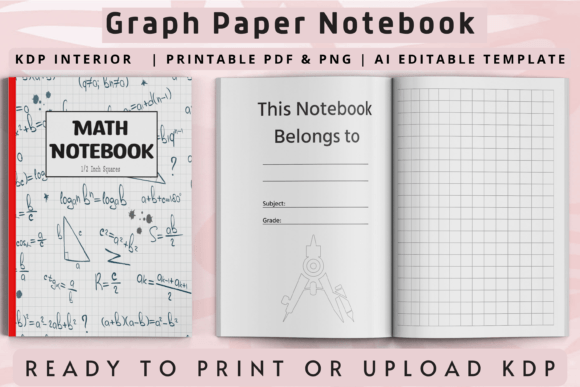
The Graph Paper Notebook with a 1/2 Inch Grid: A Practical Analysis
In the world of notebooks and specialized paper, the graph paper notebook remains a steadfast tool for technical and creative work. A specific variant, the Graph Paper Notebook with a 1/2 inch squares grid, offers a distinct set of features that cater to particular needs. Unlike standard lined journals or notebooks with larger grid sizes, this format provides a precise, medium-density framework that balances detail with clarity. Understanding its characteristics, comparing it to other available options, and identifying the situations where it excels can help you determine if it is the right tool for your projects.
What Distinguishes the 1/2 Inch Squares Graph Paper Notebook
The core feature of this notebook is, of course, its grid. A 1/2 inch square means each box on the page measures half an inch on each side. This creates a page with a higher density of lines than a 1-inch grid notebook, but with more spacious squares than a 1/4 inch or 5mm grid, which are common in engineering or detailed drafting. The 8.5 x 11 inch page size is a standard, practical format, offering ample workspace without being unwieldy. A typical offering, like a 120-page journal, provides substantial volume for a single project or term of study.
This specific Graph Paper Notebook is often designed with utility in mind. It is straightforward, focusing on the grid itself without extra decorative elements on the interior pages that might interfere with technical work. The availability of editable files, such as AI or PowerPoint formats, is a notable aspect for those using the notebook as a template for self-publishing or custom design projects. This speaks to a dual audience: end-users who simply need the paper, and creators who might modify and resell the layout.
Comparing Grid Sizes and Their Applications
Choosing a graph paper notebook involves a direct comparison of grid densities, as the square size dictates its best-fit applications.
The 1 Inch Square Grid
Notebooks with 1 inch squares offer the largest individual cells. This is excellent for broad sketches, brainstorming diagrams, or for younger students just beginning to use grids for basic math or charting. The larger squares can feel less restrictive and are easier to view from a distance. However, for precise plotting, detailed technical drawings, or complex data charts, the 1 inch grid may provide insufficient resolution, forcing you to cram multiple data points into a single square or lose granularity.
The 1/4 Inch or 5mm Square Grid
These are fine grids, favored in engineering, architectural sketching, and detailed mathematical graphing. They allow for high precision. The tradeoff is that pages can become visually busy, and for everyday note-taking or less precise design work like knitting patterns, the density of lines might be overwhelming and actually hinder clarity. Writing or drawing on a 1/4 inch grid requires a sharper pencil and more meticulous hand.
The 1/2 Inch Square Grid: A Balanced Middle Ground
The Graph Paper Notebook with a 1/2 inch squares sits between these extremes. Its grid is detailed enough for accurate two-dimensional plotting in algebra or geometry, suitable for creating clear bar charts or schematics in science classes, and spacious enough for comfortable note-taking within the squares. For design applications like knitting or crochet pattern sketching, the 1/2 inch scale can often correspond well to real-world stitch or block sizes, making translation from paper to project more intuitive. This balance makes it a versatile, general-purpose technical notebook.
Key Decision Factors and Best-Fit Situations
When evaluating if this notebook is the right choice, consider the primary use case, user skill level, and required precision.
For Students in Math and Science: A high school or college student tackling subjects like algebra, trigonometry, physics, or chemistry often needs to graph functions, draw geometric shapes, or chart experimental data. The 1/2 inch squares grid provides sufficient precision for these tasks without the clutter of a finer grid, which can make annotating graphs difficult. It is likely a better fit than a 1 inch grid for these applications, while being less intimidating than engineering paper for a general science student.
For Craft and Design Sketching: Individuals sketching patterns for knitting, embroidery, mosaic designs, or even basic floor plans may find the 1/2 inch grid ideal. It allows for a clear representation of repeats and blocks. Compared to plain paper, the grid offers automatic scaling and alignment. Compared to a 1 inch grid, it allows for more detailed designs; compared to a 1/4 inch grid, it keeps the overall pattern overview more readable.
For General Technical Note-Taking: Some professionals or hobbyists prefer to take notes within a grid for better organization of text and diagrams. The 1/2 inch squares can act as a guide for writing, helping keep lists aligned or diagrams proportioned, while still leaving enough white space within each square for legible handwriting.
When Another Option Might Be Necessary
Despite its versatility, the Graph Paper Notebook with 1/2 inch squares has limitations that dictate when an alternative is preferable.
If your work requires extreme precision—such as mechanical part sketching, circuit diagram drafting, or architectural floor plans with exact scaling—a dedicated engineering notebook with a 1/4 inch or 5mm grid, or even custom scaled paper, is the necessary tool. The 1/2 inch grid simply won't offer the required detail.
For pure writing, journaling, or linear note-taking without any graphical elements, a standard lined notebook or even a blank notebook would be more appropriate. The grid lines in a Graph Paper Notebook might become a distracting background for text-heavy work.
Furthermore, the physical format matters. A 120-page, 8.5 x 11 inch notebook is a specific size and weight. If portability is paramount—for example, for a field researcher needing a pocket-sized notebook—a smaller format graph paper book, even with the same 1/2 inch grid scaled down, would be a better alternative. The tradeoff here is between workspace area and convenience.
Evaluating the Practical Features
Beyond the grid, practical considerations include page count, paper quality, and binding. A 120-page count offers a solid balance. It's sufficient for a semester of coursework or a single large design project without being excessively bulky. The mention of editable interior and cover files is a feature aimed at a specific audience: creators on platforms like Amazon KDP. For the end-user, this is irrelevant; for someone looking to publish their own customized graph paper journals, this is a significant advantage, allowing for branding and modification before printing.
The "no bleed" specification indicates the design is intended for standard printing, where content does not extend to the edge of the page. This is typical for utilitarian notebooks and ensures graphs and notes are framed within a safe margin, preventing content from being cut off during binding or printing.
Making an Informed Choice
Selecting any specialized notebook is about matching tool to task. The Graph Paper Notebook with a 1/2 inch squares grid is a thoughtful solution for applications that demand a blend of structure and space. It compares favorably to larger grids when detail is needed and to finer grids when clarity and ease of use are priorities. By assessing whether your work involves mid-level precision graphing, technical note-taking integrated with diagrams, or craft design sketching, you can determine if this notebook's balanced characteristics fit your needs. If your requirements lean towards either extreme of precision or simplicity, or towards pure text, then exploring the alternatives in grid size or notebook style will lead you to a more suitable resource.