A Guide to Visual Alphabet Learning Resources: Evaluating the ABC Visually Learning Book
When searching for early literacy materials, parents and educators often encounter a wide array of alphabet worksheets and printables. One specific offering, the ABC Visually Learning Book, represents a distinct approach within this category. It is described as a comprehensive set of printable letter learning worksheets covering the entire English alphabet, with each page dedicated to a single letter. Understanding what this resource provides, and how it compares to other common methods, can help in selecting the most appropriate tools for a child's development.
Core Features and Distinctive Design
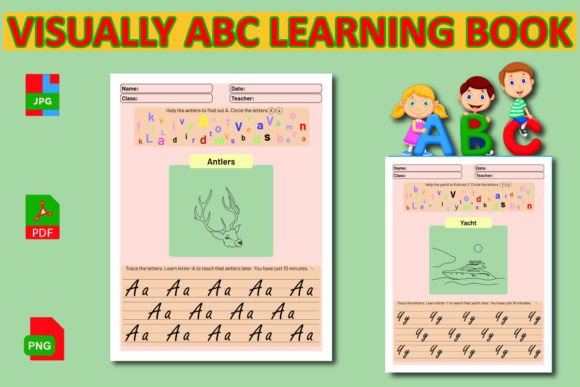
The ABC Visually Learning Book is fundamentally a digital product, available as a download comprising PDF, JPG, and PNG files. Its structure is methodical: 26 individual pages, each corresponding to one letter from A to Z. The design incorporates several learning components on each sheet. First, it visually presents the letter form. Then, it provides a space for letter identification, typically asking the child to circle the target letter among others. Following this, it offers guided practice with multiple tracing lines for writing the letter. A notable characteristic is the inclusion of a relevant illustration for each letter—a picture of an object that starts with that letter, designed as line art to be colored in.
This combination of elements makes it distinct from many single-focus printables. It integrates letter recognition, discrimination, handwriting practice, and phonetic association (through the initial sound illustration) into a unified activity per letter. The practical specifications, such as being formatted for traditional 8.5" x 11" paper and created at 300 DPI, indicate it is tailored for clear, high-quality home printing, a common requirement for KDP (Kindle Direct Publishing) interiors and home use.
Comparing Formats and Approaches to Alphabet Learning
To evaluate the ABC Visually Learning Book effectively, it's useful to consider the broader landscape of early alphabet learning resources. These typically fall into several formats: physical books, interactive digital apps, loose printable worksheets, and multi-sensory hands-on kits.
Printable Worksheets Versus Physical Workbooks
The ABC Visually Learning Book exists as a digital file set, placing it firmly in the printable worksheet category. Compared to pre-bound physical workbooks, printables like this offer significant flexibility. They allow for printing pages as needed, repeating pages for extra practice, or even printing only the letters a child is currently struggling with. A physical workbook, while often more durable and convenient for organization, locks the user into a fixed sequence and a single copy of each page. The tradeoff here is between the adaptability of digital printables and the simplicity and tangibility of a ready-made book. For a homeschool setup where a parent might want to pace lessons individually, or for supplementing a preschool curriculum with specific letter focus, the printable format can be advantageous.
Structured Worksheets Versus Play-Based Learning
The approach of the ABC Visually Learning Book is structured and worksheet-based. Each page follows a predictable pattern: look, identify, trace, color. This contrasts with more play-based or exploratory methods, such as learning letters through sensory bins, letter-shaped toys, or unstructured art projects. The worksheet approach provides clear, measurable practice and can be excellent for building specific fine motor skills (through tracing) and focused attention. However, some children, particularly very young preschoolers, may engage better with more active, less paper-bound activities. The best-fit situation for this resource might be a child who enjoys sitting with a pencil and crayons, or a learning environment that balances worksheet time with other play-based methods. Its inclusion of coloring elements attempts to bridge this gap by adding a creative, less rigid component to the page.
Key Strengths and Potential Limitations
Analyzing the described features reveals several strengths. The resource is comprehensive, covering all 26 letters systematically. The multi-step activity on a single page can create a cohesive learning session. The high-resolution illustrations and tracing lines are designed for clarity, which is crucial for young learners. Furthermore, being a digital download means immediate access and no shipping costs, which is practical for many.
Potential limitations often relate to the medium and style. As a static printable, it lacks auditory feedback or interactive correction, which educational apps might provide. The learning progression is linear (A to Z), whereas some curricula introduce letters in a different order based on phonics or ease of writing. Also, while the coloring illustration reinforces letter-sound association, the connection is limited to a single example word per letter. Some children might benefit from exposure to multiple words starting with the same sound. The resource is clearly a tool for practice and reinforcement, not a full, standalone curriculum; it would typically be used as part of a larger set of activities and lessons.
Decision Factors for Parents and Educators
When considering if the ABC Visually Learning Book is the right choice, several decision factors come into play. First, consider the child's learning style: does they respond well to paper-based activities and enjoy coloring and tracing? Second, evaluate the existing learning framework: is this meant to supplement a preschool curriculum, serve as a primary homeschool resource for letter practice, or just provide occasional extra work? Third, assess practical constraints: do you have reliable access to a printer and prefer the control and reusability of digital files over purchasing physical books?
For adults comparing options, it's also worth thinking about longevity. A well-designed printable can be used repeatedly for different children or over several years as a child revisits concepts. However, the need to organize printed sheets contrasts with the neatness of a completed workbook. Another factor is customization. While this particular set has a fixed design, some printable markets offer editable versions or themed variations (e.g., animal-themed alphabets). The ABC Visually Learning Book, with its line art illustrations, appears to follow a clear, generic aesthetic suitable for broad use.
When This Resource Fits and When Alternatives Might Be Needed
The ABC Visually Learning Book may be an excellent fit in specific scenarios. It aligns well with structured homeschool setups where parents follow a planned sequence and need consistent, high-quality practice pages. It serves as a solid resource for "letter of the week" approaches common in early preschool curricula. It is also practical for parents seeking focused tracing practice, especially given the multiple tracing lines per letter, which is more generous than some single-line printables.
However, there are situations where readers might need to look for alternatives. If a child is resistant to worksheets, more tactile resources like magnetic letters or letter stampers might be preferable as a primary tool. If the learning goal is deeper phonics integration—learning letters within word families and sounds—a resource that groups letters differently or provides more word examples might be more appropriate. Furthermore, if immediate, no-prep activities are required (e.g., during travel), a physical workbook or an educational tablet app could be more convenient than printing and organizing sheets.
Ultimately, the value of a resource like the ABC Visually Learning Book lies in its specific design intention: to provide a complete, visually clear, and multi-activity printable set for each letter of the alphabet. By understanding its structured format, comparing it to the wider range of available tools, and honestly assessing the child's needs and the learning environment, adults can make a more informed decision. It stands as a practical, comprehensive option within the printable worksheet category, particularly suited for systematic practice and integration into a broader early learning plan.