A Practical Guide to the Daffodil Flower Coloring Book for Kids
Exploring creative activities for children, adults, and even commercial publishing projects requires a clear understanding of the resources available. The Daffodil Flower Coloring Book for Kids represents a specific category of digital product designed for versatility and ease of use. It is fundamentally a collection of line-art illustrations centered on the cheerful daffodil flower, packaged as a downloadable digital file suite.
What Distinguishes This Digital Coloring Book
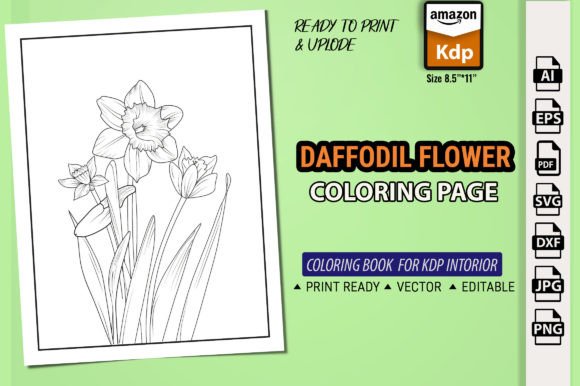
Unlike a simple PDF you might find for free online, this product is structured as a complete digital asset package. Its core distinction lies in the included formats and the underlying file type. The illustrations are created as vector artwork in Adobe Illustrator, which is a significant point for comparison with other coloring book options.
Vector graphics are not composed of pixels but of mathematical paths, meaning they are infinitely scalable without losing clarity or sharpness. This technical foundation makes the Daffodil Flower Coloring Book for Kids inherently modifiable. You can resize individual flowers, change line weights, or even extract elements for other projects without quality degradation, which is a common limitation with raster-based (e.g., standard JPG) coloring pages.
Format Comparison and Practical Implications
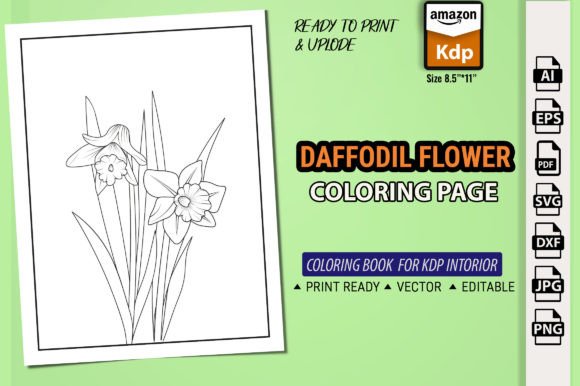
The provided ZIP file contains seven distinct formats: AI, PDF, EPS, DXF, PNG, SVG, and JPG. This array caters to different user goals and technical capabilities.
- AI and EPS: These are the native source files for Adobe Illustrator and compatible vector programs. They offer full editing control. This is a key alternative to purchasing a coloring book where you only receive a final, locked PDF.
- PDF: This is the print-ready, standardized format. Its inclusion is crucial for direct upload to platforms like Amazon KDP, fulfilling the “Print Ready” requirement.
- SVG and DXF: These vector formats broaden usability beyond graphic design. SVG is widely used for web and cutting machines (like Cricut), while DXF is common in CAD and engraving software. This transforms the book from a mere coloring activity into a potential resource for craft projects.
- PNG and JPG: These raster formats provide quick, easy-to-use images for simple digital sharing or basic printing, though they lack the scalability of the vector files.
A practical tradeoff here is complexity versus convenience. A user solely wanting to print pages for a child might find a single PDF simpler. However, the multi-format approach of the Daffodil Flower Coloring Book for Kids supports a wider range of applications, from professional publishing to home crafts, albeit requiring slightly more file management.
Evaluating Fit: Kids, Adults, and Commercial Use
The product’s title suggests a primary audience of children, but the “For Adult KDP Interior” notation highlights its dual-purpose nature. This is an important point of comparison.
For children’s use, the clear, simple daffodil outlines are appropriate. The 8.5” x 11” trim size is standard for home printing. However, the vector source files are likely irrelevant for a parent simply printing a fun activity. Their value in this context is the guarantee of clean, non-blurry lines at any print size.
For adult coloring, the subject matter—a single flower type—may be a limitation compared to books with diverse, complex patterns. Adults seeking intricate mandalas or varied botanical scenes might need another option. Yet, for adults who enjoy thematic, nature-focused simplicity or who use coloring for relaxation rather than artistic challenge, this focused approach can be ideal.
The commercial and publishing use-case is where this product’s strengths are most evident. The print-ready PDF and editable AI files directly serve Amazon KDP (Kindle Direct Publishing) interior creation. A self-publisher can modify the layout, combine pages, or adjust designs before uploading. Comparing this to purchasing a physical coloring book to scan and use would reveal immense tradeoffs in quality, legality, and effort.
Decision Factors: When This Option Is the Right Choice
Choosing the Daffodil Flower Coloring Book for Kids depends on weighing several factors against alternative resources.
First, consider the need for modification. If your goal is static use—printing as-is—a free or low-cost single PDF might suffice. If you anticipate wanting to adjust sizes, create derivative work, or use illustrations in different software, the vector source files become a decisive advantage.
Second, assess the scope of application. Are you only coloring, or might you also explore vinyl cutting, laser engraving, or web graphic creation? The inclusion of SVG and DXF formats caters to this broader scope, whereas most standard coloring books do not.
Third, evaluate your technical comfort. Utilizing AI or EPS files requires access to and basic knowledge of Adobe Illustrator or similar software. For users without this, the PNG, JPG, and PDF files are the practical subset. The product offers a gradient of usability from simple to advanced.
Strengths and Situational Limitations
A core strength of this product is its functional transparency. The trim size (8.5×11 inches), the software version (CS6), and the exact file list are specified, reducing uncertainty. This level of detail is often absent in alternative offerings.
Another strength is its theme consistency. A book focused solely on daffodils provides a cohesive learning or creative theme, which can be beneficial for educational units on spring or specific botanicals. Conversely, its limitation is the lack of variety. A child or adult preferring a mix of flowers, animals, and patterns would find this too narrow, making a more generalized coloring book a better fit.
The “print-ready” designation for KDP is a significant strength for entrepreneurs, but it carries the implicit tradeoff of requiring the user to handle publishing logistics, cover design, and marketing themselves. It is a resource, not a complete service.
Comparing Digital Asset Approaches
In the broader category of digital printable coloring books, approaches vary. Some products offer only low-resolution JPGs bundled in a ZIP file. Others provide high-resolution PDFs but no source files. The Daffodil Flower Coloring Book for Kids sits in a middle-to-high tier by offering both the final output (PDF) and the raw, editable assets (AI, EPS).
This approach is best-fit for users who value long-term flexibility and potential reuse. For a classroom teacher creating year-round spring materials, editable files allow for adapting the same daffodil art into worksheets, posters, or craft templates. A one-time user, however, might perceive the extra files as unnecessary clutter.
Making an Informed Selection
Ultimately, selecting this product hinges on aligning its specific attributes with your project’s requirements. If you are a parent, teacher, hobbyist, or micro-publisher whose needs include theme-specific daffodil art, the ability to customize, and the potential for multiple use-cases beyond coloring, this digital package presents a compelling and practical option.
If your requirements are for a one-off activity with maximum variety, or if you lack any intention or capability to edit source files, then seeking a simpler, perhaps more diverse, coloring book collection would be a more straightforward path. The key is to recognize that the Daffodil Flower Coloring Book for Kids is not just a book of pages; it is a modular graphic asset built around a friendly spring flower, and its value is directly proportional to how much you intend to use, adapt, and apply those assets.